Tom Young Tom Young
0 คอร์สที่ลงทะเบียนเรียน • 0 คอร์สที่สมบูรณ์ประวัติส่วนตัว
OGEA-103 Valid Test Practice | Test OGEA-103 Sample Questions
It is known to us that to pass the OGEA-103 exam is very important for many people, especially who are looking for a good job and wants to have a OGEA-103 certification. Because if you can get a certification, it will be help you a lot, for instance, it will help you get a more job and a better title in your company than before, and the OGEA-103 Certification will help you get a higher salary. We believe that our company has the ability to help you successfully pass your exam and get a OGEA-103 certification by our OGEA-103 exam torrent.
The Open Group OGEA-103 (TOGAF Enterprise Architecture Combined Part 1 and Part 2) Exam is a certification exam for enterprise architects who want to prove their expertise in the field of enterprise architecture. OGEA-103 exam is designed to test the candidates' knowledge and skills in both Part 1 and Part 2 of the TOGAF Standard. The TOGAF Standard is a framework that provides guidelines for enterprise architects to create and manage enterprise architectures that meet the business needs of an organization.
>> OGEA-103 Valid Test Practice <<
The Open Group OGEA-103 PDF Questions - Increase Your Exam Passing Chances
Our web-based practice exam software is an online version of the The Open Group OGEA-103 practice test. It is also quite useful for instances when you have internet access and spare time for study. To study and pass the certification exam on the first attempt, our The Open Group OGEA-103 Practice Test software is your best option. You will go through The Open Group OGEA-103 exams and will see for yourself the difference in your preparation.
The Open Group TOGAF Enterprise Architecture Combined Part 1 and Part 2 Exam Sample Questions (Q85-Q90):
NEW QUESTION # 85
In which phase of the ADM cycle do building blocks become implementation-specific?
- A. Phase C
- B. Phase E
- C. Phase B
- D. Phase D
Answer: B
Explanation:
Building blocks are reusable components of business, IT, or architectural capability that can be combined to deliver architectures and solutions. Building blocks can be defined at various levels of detail, depending on the stage of architecture development. In the earlier phases of the ADM cycle (A to D), building blocks are defined in generic terms, such as logical or physical, to provide a high-level view of the architecture. In Phase E: Opportunities and Solutions, building blocks become implementation-specific, meaning that they are linked to specific products, standards, technologies, and vendors that are available in the market. This phase also identifies the delivery vehicles, such as projects, programs, or portfolios, that will realize the building blocks12 Reference: 1: The TOGAF Standard, Version 9.2, Part II: Architecture Development Method (ADM), Chapter 23: Phase E: Opportunities and Solutions 2: The TOGAF Standard, Version 9.2, Part IV: Architecture Content Framework, Chapter 36: Building Blocks
NEW QUESTION # 86
Scenario:
You are working as an Enterprise Architect within an Enterprise Architecture (EA) team at an electric vehicle manufacturer. The company produces electric cars and battery systems. The goal of the company is to build the best technology and software platform for electric vehicles.
The company has decided to introduce a major change to its vehicle design over a five-year period. This will be a cross-functional effort between hardware and software teams, delivering significant new features in the vehicles they manufacture. It is planned to be developed in phases.
An architecture to support strategy has been completed with a roadmap for a set of projects.
The EA team has inherited the architecture for the hardware and software automotive platform used by current vehicles, some of which can be carried over to the new vehicle design. The EA team has started to define which parts of the architecture to carry forward.
The presentation and access to different variations of data that the company plans to offer through its vehicles creates an architecture challenge. The application portfolio and supporting infrastructure must connect with multiple cloud services and data repositories in different countries to be able to handle large- scale data.
Enough of the Business Architecture has been defined, so that work can commence on the Information Systems and Technology Architectures. These architectures need to be defined to support the primary business services that the company plans to provide. These services will manage and process the data created by vehicles, paving the way for self-driving vehicles in the future.
The company uses the TOGAF Standard as the basis for its Enterprise Architecture framework.
The EA team reports to the Chief Technical Officer (CTO), who is the sponsor of the EA program.
The CTO requires that the EA team follow the purpose-based EA Capability model as described in:
The TOGAF Series Guide: A Practitioners' Approach to Developing Enterprise Architecture Following the TOGAF ADM.
Refer to the scenario:
You have been asked how to decide and organize the work to deliver the requested architectures.
Based on the TOGAF standard, which of the following is the best answer?
- A. You research leading data companies, using your findings to help in developing high-level Target Data, Application, and Technology Architectures. You review the Architecture Vision to determine the level of detail, time, and scope of the ADM cycle phases required for architecture development for the project. You identify and estimate the cost of the main work packages. You then create an Architecture Roadmap and request the Architecture Board to approve the roadmap. You then start the project.
- B. You look outside the company to study how other companies organize their data models and application portfolios. You request just enough architecture description for the Application, Data, and Technology Architectures to identify different options. For each project, this includes identifying architecture and solution building blocks. You then identify solution providers and perform a readiness assessment on the new approaches.
- C. You look to the superior architecture to help plan your approach. You identify projects, dependencies, and synergies, then decide the order for starting the projects. You then develop high- level architecture descriptions. For each project, you determine how much work is needed, identify reference architectures, and candidate building blocks. You identify the resource needs taking into account cost and value. You document the different options, risks, and ways to control them to enable feasibility analysis and trade-offs with the stakeholders.
- D. You commence an iteration of ADM Phase A, identifying the stakeholders and revising the Architecture Vision. You perform a Stakeholder Analysis and update the Stakeholder Map created for the strategic architecture so it reflects the stakeholders who are now the most important to the projects that are to be developed. You then request the CTO to make some choices about the Architecture Roadmap and update the Implementation and Migration Plan to reflect the choices.
Answer: C
Explanation:
The correct answer is C, as it aligns with the TOGAF ADM approach and best practices for organizing architecture work in a phased and structured manner.
Analysis of the Correct Answer (Option C):
* Identifying Projects, Dependencies, and Synergies
* The scenario describes a phased approach to vehicle development over five years.
* Identifying dependencies ensures a logical and structured rollout of technology and business capabilities.
* Developing High-Level Architecture Descriptions
* Since Business Architecture is already defined, it is now time to develop high-level descriptions of Information Systems and Technology Architectures.
* TOGAF emphasizes incremental and iterative refinement, meaning that starting with high- level descriptions is a logical first step.
* Determining Workload and Resource Allocation
* TOGAF ADM Phase B, C, and D involve creating architecture descriptions.
* Understanding how much work is required ensures efficient resource planning and allocation.
* Identifying Reference Architectures and Building Blocks
* Using reference architectures and reusable architecture building blocks (ABBs) is a key best practice in TOGAF.
* This enables efficiency and consistency in architecture development.
* Evaluating Costs, Risks, and Feasibility
* TOGAF emphasizes a risk-aware approach to enterprise architecture.
* Documenting options, risks, and control measures ensures feasibility before execution.
Why Other Options Are Incorrect?
* Option A: Initiating ADM Phase A Again
* Incorrect because the scenario states that the Architecture Vision has already been completed.
* Phase A is used for initial vision-setting, but at this point, the focus is on executing defined architectures.
* Option B: Researching Data Companies for Target Architecture Development
* Incorrect because the focus should be on defining internal architectures rather than external research.
* While benchmarking best practices can be useful, it is not the primary activity at this stage.
* Option D: Studying Other Companies and Performing Readiness Assessment
* Incorrect because the focus should be on leveraging the organization's existing architecture and resources.
* Solution provider readiness assessments are typically part of procurement, not enterprise architecture development.
References:
* TOGAF Standard, ADM Guidelines and Techniques
* TOGAF Standard, ADM Phase B, C, and D - Developing the Architecture
* The TOGAF Series Guide: A Practitioners' Approach to Developing Enterprise Architecture Following the TOGAF ADM
NEW QUESTION # 87
Complete the sentence. The four purposes that typically frame the planning horizon, depth and breadth of an Architecture Project, and the contents of the EA Repository are Strategy, Portfolio,
- A. Project, and Solution Delivery.
- B. Discreet, and Cohesive.
- C. Segment, and End-to-end Target Architecture.
- D. Subordinate, and Superior Architecture.
Answer: C
Explanation:
The planning horizon, depth, and breadth of an Architecture Project, along with the contents of the EA Repository, are typically framed by Strategy, Portfolio,Segment, and End-to-end Target Architecture. The
'Segment' refers to a part of the organization, typically addressed in a Segment Architecture, while 'End-to-end Target Architecture' encompasses the complete view of the planned architecture across the entire organization.
NEW QUESTION # 88
Consider the following descriptions of deliverables consumed and produced across the TOGAF ADM cycle.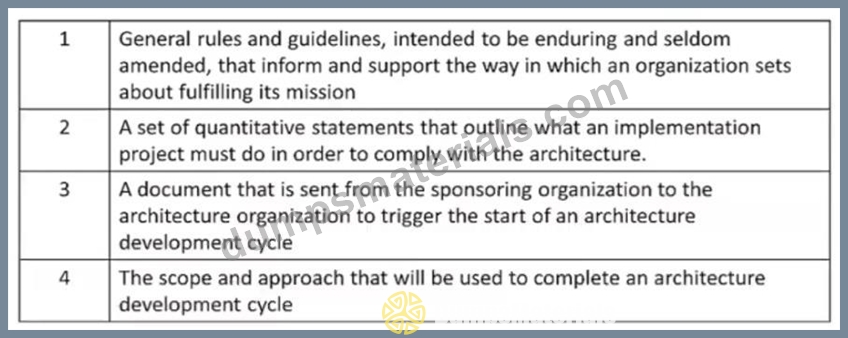
Which deliverables match these descriptions?
- A. 1 Architecture Requirements Specification - 2 Request for Architecture Work - 3 Statement of Architecture Work - 4 Architecture Principles
- B. 1 Statement of Architecture Work - 2 Architecture Principles - 3 Architecture Requirements Specification - 4 Request for Architecture Work
- C. 1 Architecture Principles - 2 Architecture Requirements Specification - 3 Request for Architecture Work
- 4 Statement of Architecture Work - D. 1 Request for Architecture Work - 2 Statement of Architecture Work - 3 Architecture Principles - 4 Architecture Requirements Specification
Answer: D
Explanation:
Explanation
The Request for Architecture Work is a deliverable that is sent from the sponsor and triggers the start of an architecture development cycle. It defines the scope, budget, schedule, and deliverables for a specific architecture project. The Statement of Architecture Work is a deliverable that is produced by the architect and defines the approach and resources needed to complete an architecture project. It forms the basis of a contractual agreement between the sponsor and the architecture organization. The Architecture Principles are a deliverable that is produced by the architect and defines the general rules and guidelines for the architecture work. They reflect the business principles, business goals, and business drivers of the organization. The Architecture Requirements Specification is a deliverable that is produced by the architect and defines the requirements that govern the architecture work. It covers both functional and non-functional requirements as well as constraints and assumptions.
NEW QUESTION # 89
What does the TOGAF ADM recommend for use in developing an Architecture Vision document?
- A. Gap Analysis
- B. Requirements Management
- C. Business Scenarios
- D. Architecture Principles
Answer: C
Explanation:
Business scenarios are a technique recommended by the TOGAF ADM for use in developing an Architecture Vision document12. Business scenarios are a means of capturing the business requirements and drivers, the processes and actors involved, and the desired outcomes and measures of success34. Business scenarios help to create a common vision and understanding among the stakeholders, and to identify and validate the architecture requirements . Business scenarios also provide a basis for analyzing the impact and value of the proposed architecture. References:
*The TOGAF Standard, Version 9.2 - Phase A: Architecture Vision - The Open Group
*TOGAF Standard - Introduction - Phase A: Architecture Vision
*The TOGAF Standard, Version 9.2 - Definitions - The Open Group
*Business Scenarios - The Open Group
*[The TOGAF Standard, Version 9.2 - Architecture Requirements Specification - The Open Group]
*[The TOGAF Standard, Version 9.2 - Architecture Vision - The Open Group]
*[The TOGAF Standard, Version 9.2 - Business Transformation Readiness Assessment - The Open Group]
NEW QUESTION # 90
......
They work together and put all their expertise, knowledge, and experience and make sure the top standard of DumpsMaterials OGEA-103 exam questions all the time. So we can say that the DumpsMaterials OGEA-103 exam practice test questions are the ideal study material for quick TOGAF Enterprise Architecture Combined Part 1 and Part 2 Exam (OGEA-103) exam preparation. The DumpsMaterials OGEA-103 exam questions are real, valid, and updated as per the latest The Open Group OGEA-103 exam syllabus and you can trust it and start The Open Group OGEA-103 exam preparation right now.
Test OGEA-103 Sample Questions: https://www.dumpsmaterials.com/OGEA-103-real-torrent.html
- Valid OGEA-103 Cram Materials 📮 Valid OGEA-103 Cram Materials 💦 Practice OGEA-103 Mock 🕺 Search for ⮆ OGEA-103 ⮄ on ▶ www.testsdumps.com ◀ immediately to obtain a free download 📟OGEA-103 Cert
- 2025 Reliable OGEA-103 Valid Test Practice | TOGAF Enterprise Architecture Combined Part 1 and Part 2 Exam 100% Free Test Sample Questions 🔑 Search on 《 www.pdfvce.com 》 for “ OGEA-103 ” to obtain exam materials for free download 💢Sample OGEA-103 Questions Pdf
- OGEA-103 Valid Test Simulator 👵 OGEA-103 Valid Test Simulator ✉ Pdf OGEA-103 Format 🥩 Open { www.real4dumps.com } enter ➥ OGEA-103 🡄 and obtain a free download 🆚OGEA-103 Valid Test Simulator
- Valid OGEA-103 Test Simulator ⛳ Valid OGEA-103 Test Simulator 💾 OGEA-103 Exam Dumps.zip 😽 Simply search for “ OGEA-103 ” for free download on ( www.pdfvce.com ) 🕥Practice OGEA-103 Mock
- Valid OGEA-103 Test Simulator 😾 Test OGEA-103 Simulator 💄 OGEA-103 Clear Exam 💌 Open ➽ www.torrentvalid.com 🢪 and search for 「 OGEA-103 」 to download exam materials for free 🔭Exam OGEA-103 Cram
- OGEA-103 Reliable Test Preparation 🛰 OGEA-103 Cert 🌸 Download OGEA-103 Demo 🈺 The page for free download of ( OGEA-103 ) on ➡ www.pdfvce.com ️⬅️ will open immediately 🐏Practice OGEA-103 Mock
- OGEA-103 Valid Test Notes 🖐 Practice OGEA-103 Mock 👩 OGEA-103 Test Pattern 😵 Open ⏩ www.getvalidtest.com ⏪ and search for ( OGEA-103 ) to download exam materials for free 😽Exam Topics OGEA-103 Pdf
- How to Prepare for OGEA-103 Certification Exam? 🔜 Open 《 www.pdfvce.com 》 enter ➥ OGEA-103 🡄 and obtain a free download 🅾OGEA-103 Valid Test Simulator
- OGEA-103 Reliable Test Preparation 🤢 OGEA-103 Exam Dumps.zip 🚀 Download OGEA-103 Demo 🚨 Immediately open ▶ www.pdfdumps.com ◀ and search for ▷ OGEA-103 ◁ to obtain a free download 🟡Test OGEA-103 Simulator
- Free PDF 2025 OGEA-103: Authoritative TOGAF Enterprise Architecture Combined Part 1 and Part 2 Exam Valid Test Practice 👝 Simply search for ☀ OGEA-103 ️☀️ for free download on ▛ www.pdfvce.com ▟ 💔Test OGEA-103 Result
- 2025 Reliable OGEA-103 Valid Test Practice | TOGAF Enterprise Architecture Combined Part 1 and Part 2 Exam 100% Free Test Sample Questions 🤫 Download “ OGEA-103 ” for free by simply entering ✔ www.pdfdumps.com ️✔️ website 📟Test OGEA-103 Simulator
- OGEA-103 Exam Questions
- learnonline.sprintlearn.net www.gpzj.net virtual.proacademy.uz tadika.israk.my japatribe.com lms.clodoc.com newsusas.com lb.abcbbk.com phdkhulani.com digitalenglish.id